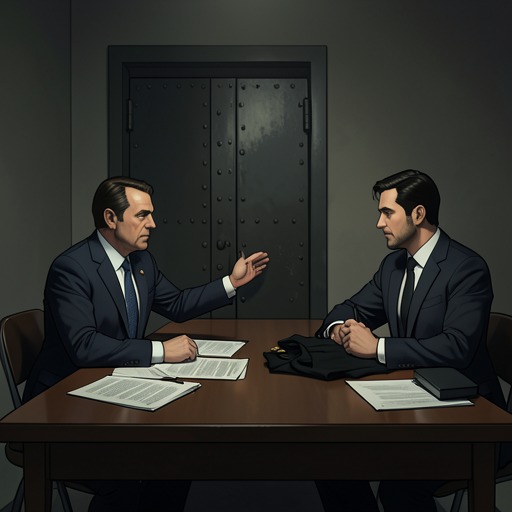
Marvie and Leif’s business partnership
Naked LunchMarvie and Leif’s business partnership is the operating basis of Interzone Imports Unlimited, an Interzone concern specializing in pharmaceuticals and related services. Their trade rests on a precarious mixture of opportunism, dubious merchandise, and improvised credit. The partners can cooperate long enough to pursue a lucrative deal, but the same deal quickly turns into a contest over commissions, paperwork, and who deserves credit. Their alliance is therefore less a bond of trust than a practical arrangement repeatedly strained by the profits it seeks to secure.
The Partners and Their Enterprise
Interzone Imports Unlimited consists of Marvie and Leif the Unlucky. Pharmaceuticals are its principal line, and it also operates a round-the-clock Pro station offering six-way coverage, a sideline that reflects the business’s reach into related products and services. The company’s identity is not built around a stable, reputable trade: the wider commercial world around the partners includes cut medicines, counterfeit goods, and products whose defects shift danger onto their users. Marvie’s earlier history includes a part in spreading such merchandise across the world, from adulterated shark repellent and cut antibiotics to condemned parachutes and inactive medical supplies.
The partners bring markedly different histories to the company. Marvie says he has been in Interzone since “the year before one” and was retired from an unspecified State Department position “for the good of the service.” Once described as handsome in a crew-cut, college-boy fashion, he has since become heavier, with a sagging face and lumps beneath his chin. His former official standing and his present place in dubious commerce sit side by side, without any account of a clean break between them.
Leif the Unlucky is a tall, thin Norwegian with a patch over one eye and a fixed, ingratiating expression. His record is a catalogue of failed schemes: raising frogs, chinchillas, fighting fish, rami, and cultured pearls; proposing a cemetery business; trying to corner the condom market; and attempting mail-order and patent-medicine ventures. His personal misfortunes are similarly extensive, including injuries, illness, addiction, and mistreatment by medical practitioners. In the partnership, this history makes Leif a figure whose commercial ambition persists despite a long sequence of reversals, rather than evidence that he has found a dependable enterprise.
The Whale-Dreck Shipment
The clearest test of the partnership comes when the two pursue a shipload of K.Y. made from whale dreck. The material is described as rejected waste from the processing of whales, foul-smelling and without an established use; the proposed cargo is quarantined by the Board of Health in Tierra del Fuego. The deal’s appeal lies in the prospect of a large commission, not in any demonstrated value or safety of the product. Its route and regulatory obstacles are part of the opportunity: the partners hope to turn a questionable, quarantined cargo into profit by arranging the transaction.
They plunge into the venture and enlist intermediaries, including a Greek shipping agent and a shift of customs inspectors. The arrangement becomes a network of services and influence rather than a straightforward sale. These dependencies make the partners’ cooperation necessary: the shipment cannot be pursued through their own efforts alone. At the same time, every intermediary and document provides another point at which control of the transaction—and its expected proceeds—can be contested.
Rivalry, Documents, and Temporary Reconciliation
The partnership breaks into open dispute at the embassy, where the two denounce one another and are sent away through a back door. Their argument is specifically about the commission and the means of securing it. Marvie claims the bill of lading; Leif insists that the check will be made out in his name. Leif will not release the bill of lading until his share is placed in escrow, while Marvie accuses him of trying to take the commission. Each treats possession of a different piece of the transaction as leverage, so their disagreement is not simply personal friction: it concerns which partner can control the documents that turn the proposed deal into payment.
The confrontation does not end the partnership. After their accusations, the two declare that they might as well make peace, shake hands without enthusiasm, and exchange pecks on the cheek. The reconciliation is pointedly thin: their outward agreement restores the working relationship but does not resolve the competing claims that produced the quarrel. The deal continues for months, and they employ an Expeditor to advance it, making clear that the renewed cooperation remains dependent on further brokerage and delay.
Proceeds and the Partnership’s Limits
Eventually Marvie emerges with a check for forty-two Turkestan kurds, drawn on an anonymous South American bank and routed through Amsterdam. Clearing it is expected to take roughly eleven months. The apparent success is therefore neither immediate cash nor a secure conclusion. Marvie shows a photostatic copy rather than the original, wary that someone might damage the signature, and the check functions as visible proof of a promised return while remaining distant from usable money.
Marvie says that he has already spent the expected proceeds buying Penstrep for Ali, who is again suffering from an infection. When he does buy himself a beer, he pays with a blackened coin and receives no welcome from the waiter. The contrast between the elaborate international transaction and this small, awkward payment undercuts the glamour of the commission: the partners’ success is entangled with debt, illness, delayed funds, and petty economies. The partnership secures a deal, but the evidence does not show it becoming a stable or trusting association. Its defining pattern remains cooperation under pressure, rivalry over value and control, and a reconciliation just sufficient to keep the business moving.